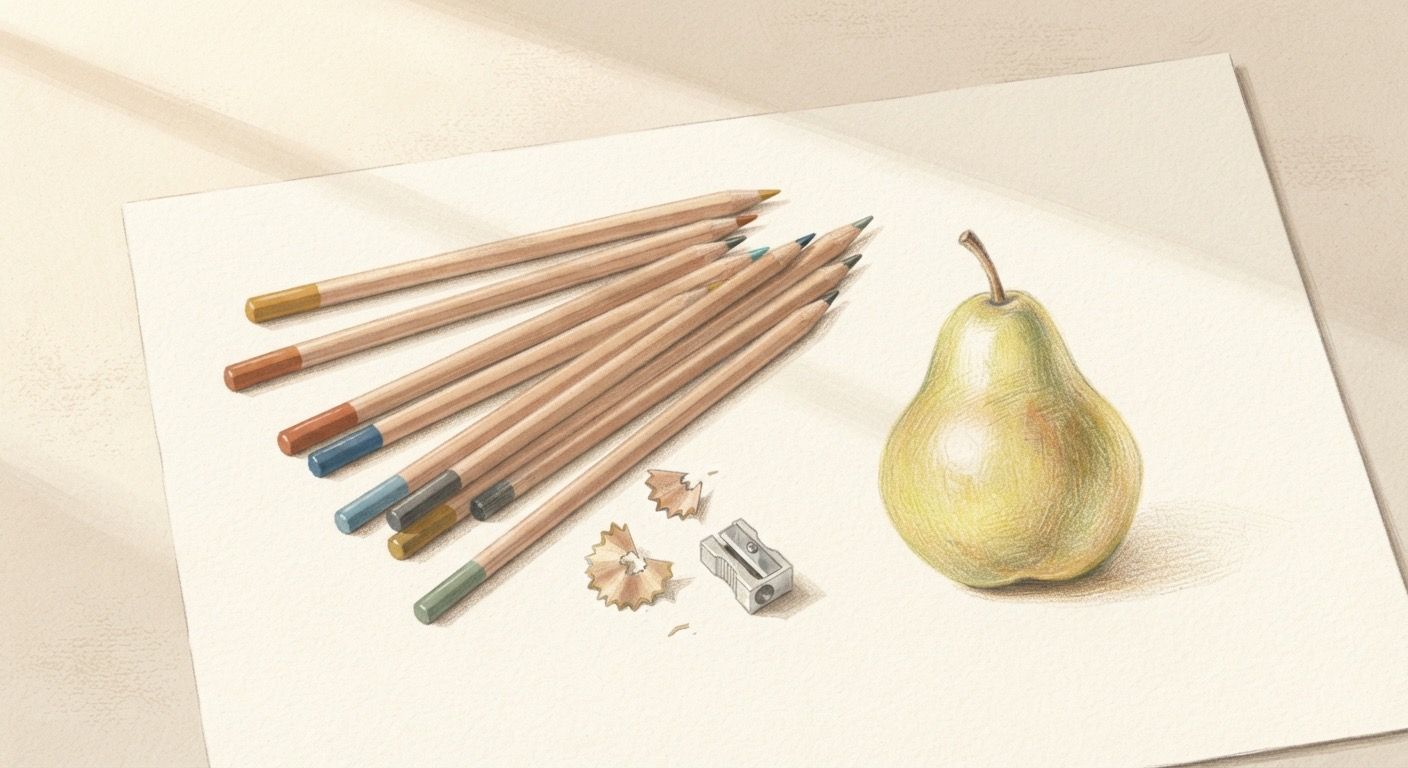
“Best colored pencils” means two different things. A colorist filling in a printed coloring book wants smooth color, easy blending and lots of shades for little money. An artist building a realistic portrait wants a core that takes ten layers, burnishes to a painted finish and stays put for years. The right set depends on which of those you are.
Research-based, not hands-on tested. I compared the makers’ stated core types, counts and labeling, checked each listing and variant, and explain the difference between pencil types from long-established technique. I show no swatches or layer counts of my own. My method.
The short answer
- Coloring books and journalinga budget 72-color soft-core set such as KALOUR covers it, with numbered barrels to keep track of shades.
- Fine art, portraits, realisma large soft-core artist set such as Prismacolor Premier 150, which layers and burnishes to a smooth, painterly finish.
- Either waypractice on paper with some tooth. A pencil can only build layers if the paper can hold them.
How I chose
- Core type and softness, as each maker states it, because it decides how color lays down and blends.
- Range, so you can shade with color instead of pressing harder.
- Labeling and identification: numbered or named barrels and stated safety conformance.
- Fit for the job: a coloring-book set and a fine-art set are judged against different needs.
Coloring books vs fine art: what changes
| Coloring books | Fine art | |
|---|---|---|
| Paper | Printed, often thin and smooth | Toothy drawing paper, Bristol, pastel paper |
| Layers | One to three | Many, then burnished |
| Range | Lots of colors, cheaply | Fewer duplicates, more control |
| Lightfastness | Rarely matters | Matters for work you display or sell |
Wax-based vs oil-based pencils
Wax-based cores, like Prismacolor Premier, are soft and creamy. They lay down rich color with little pressure and blend and burnish well. The costs: points wear down quickly, cores can break inside the wood if dropped, and heavy layers can develop wax bloom, a light haze that buffs off.
Oil-based cores, like Faber-Castell Polychromos, are firmer. They hold a sharp point for fine detail, smudge less and do not bloom. They feel less buttery and take more layers to reach the same saturation.
Many artists use both: wax-based for rich base layers, oil-based for crisp details on top.
The picks
 Research-based
Prismacolor Premier Colored Pencils, 150 Count
Best for layering and blending
Paid link · I may earn from it
- Count
- 150
- Core
- Soft, thick (per Prismacolor)
The large soft-core set many colored-pencil artists grow into: creamy laydown that blends and burnishes to a painted look, in a range wide enough that you mix less.
The 150-color set is the size many colored-pencil artists grow into: you spend less time mixing near-matches and more time on the drawing. Soft cores make it the natural fit for burnished realism and smooth blends. Handle it like a fragile instrument: do not drop pencils, and sharpen with a sharp blade or a helical sharpener.
Good fit if
- Realism and portraits built up in many layers
- Adult coloring on good paper when you want smooth, rich color
- A one-time gift for someone serious about colored pencil
Skip it if
- You press hard or sharpen to a needle point often; soft cores break more easily
- You need certified lightfastness for every color in work you will sell
All maker specs
- Count
- 150
- Core
- Soft, thick (per Prismacolor)
- Case
- Storage case (per listing)
Worth knowing
- Lightfastness varies by color; check Prismacolor's chart before using a color for work on display.
- Wax-rich pencils can develop a light haze called wax bloom; a light buff or fixative removes it.
Specs are the maker's own figures from the product listing, not my measurements. Listing checked October 11, 2026 for this exact variant: 150-count assorted (model 1800059).How I pick
 Research-basedDeal
KALOUR 72 Colored Pencils
Best for coloring books on a budget
$9.99Typical price: $11.99Save 17%
as of Nov 3, 2026, 11:23 UTCDetails
Price and availability show on Amazon.
Paid link · I may earn from it
- Count
- 72
- Core
- Soft (per listing)
A low-cost 72-color set for coloring books and practice. Numbered barrels make it easy to swatch, follow color-by-number guides and reorder what you use most.
For coloring books and journaling, KALOUR’s 72-color set offers a soft core, numbered and named barrels and a range wide enough to shade each color family. The numbering makes it easy to swatch a reference chart and follow color-by-number pages.
Good fit if
- Adult coloring books and journaling
- Kids from 5 who have outgrown crayons
- Testing whether you enjoy colored pencil before buying a premium set
Skip it if
- You want many layers and burnishing for realism; premium soft cores do more there
All maker specs
- Count
- 72
- Core
- Soft (per listing)
- Barrels
- Basswood, each with a number and color name
- Safety label
- ASTM D-4236 and EN71-3 (per listing)
- Ages
- 5 and up (per listing)
Worth knowing
- Budget pencils generally take fewer layers than premium artist pencils, so use light pressure and fewer passes.
Specs are the maker's own figures from the product listing, not my measurements. Listing checked October 11, 2026 for this exact variant: 72-count (model KA-CPS72-KID).How I pick
 Research-based
Fuxi 9 × 12 in Spiral Sketchbook, 100 Sheets
Paper to practice on
Paid link · I may earn from it
- Size
- 9 × 12 in, top spiral
- Paper
- 100 gsm (68 lb), acid-free, white
An everyday practice pad for dry media: a toothy, acid-free 100 gsm sheet, a top spiral that stays out of the way of either hand, and enough pages to fill without guilt.
Colored pencil needs paper tooth to hold layers. A 100 gsm toothy drawing pad like this one is a fine, inexpensive place to practice layering and blending before moving to heavier art papers for finished pieces.
Good fit if
- Daily sketching in graphite, charcoal and colored pencil
- Students and art classes
- Adding to any drawing gift
Skip it if
- You paint in watercolor or use alcohol markers; 100 gsm is too light for wet media and bleed
All maker specs
- Size
- 9 × 12 in, top spiral
- Paper
- 100 gsm (68 lb), acid-free, white
- Sheets
- 100, micro-perforated
- Covers
- Rigid front and back
- Made for
- Graphite, colored pencil, charcoal, pastel
Worth knowing
- The maker positions this pad for dry media. For markers use marker paper; for watercolor use 300 gsm watercolor paper.
Specs are the maker's own figures from the product listing, not my measurements. Listing checked October 11, 2026 for this exact variant: Brown cover, 9 × 12 in, pack of 1.How I pick
Colored pencils: a student set or an artist set
KALOUR 72 Colored Pencils
Adult coloring books and journaling; numbered barrels make swatching easy.
View on AmazonPrismacolor Premier Colored Pencils, 150 Count
Realism and portraits built up in many layers, then burnished.
View on AmazonCompare the specs
Two colored pencil sets, makers' specs
| Set | Count | Core | Price | Shop |
|---|---|---|---|---|
| My pickPrismacolor Premier Colored Pencils, 150 Count | 150 | Soft, thick (per Prismacolor) | $139.99as of Nov 3, 2026, 11:23 UTCDetails | View on Amazon |
| KALOUR 72 Colored Pencils | 72 | Soft (per listing) | $9.99as of Nov 3, 2026, 11:23 UTCDetails | View on Amazon |
Layering and burnishing in four steps
- Start light. Use gentle pressure and let the paper’s tooth show. Heavy early layers fill the tooth and stop later layers from sticking.
- Build value with layers, not pressure. Several light passes give richer color than one heavy pass.
- Blend. Go over transitions with a lighter color, a colorless blender pencil, or (for adults, in a ventilated room) a little odorless mineral spirits on a brush.
- Burnish last. Heavy pressure with a light color or a blender fills the remaining tooth and gives a smooth, painted look. After this, the area takes few more layers.
Sharpening soft cores without breaking them
- Use a sharp hand sharpener with a fresh blade, or a helical crank sharpener; dull blades snap soft cores.
- Do not drop pencils. A cracked core inside the wood breaks again at every sharpening.
- For long points, a craft knife and a sanding block give the most control.
The paper matters
Smooth printer paper takes only a layer or two. For art you want tooth: drawing paper, Bristol vellum, or pastel paper for toned work. For finished pieces, heavier paper also resists the dents and buckling that come from burnishing. See my sketchbook and paper guide for weights and surfaces.
Prismacolor vs Polychromos, briefly
Prismacolor Premier is the soft, wax-rich option known for fast, saturated laydown and burnishing. Polychromos is the firm, oil-based option known for sharp points and precision. Neither is “better”; they suit different hands and styles. If you press lightly and love detail, try oil-based. If you want rich color quickly, try wax-based.
Questions
How many colors do I need?
For coloring books, 48 to 72 is plenty. For fine art, a large set saves mixing, but many artists build a working set of the 24 to 36 colors they actually use and replace those individually.
Are colored pencils lightfast?
It varies by color and brand. Check the maker’s lightfastness chart before using a color in work that will hang in daylight, and frame finished work behind UV-filtering glazing.
What is wax bloom and how do I remove it?
A whitish haze that rises on heavily layered wax-based pencil work. Wipe it gently with a soft cloth; a light spray of workable fixative helps stop it returning.
Are these pencils good for kids?
KALOUR lists ages 5 and up. For young children, choose sturdy cores and supervise sharpening. See my kids’ art kit guide.