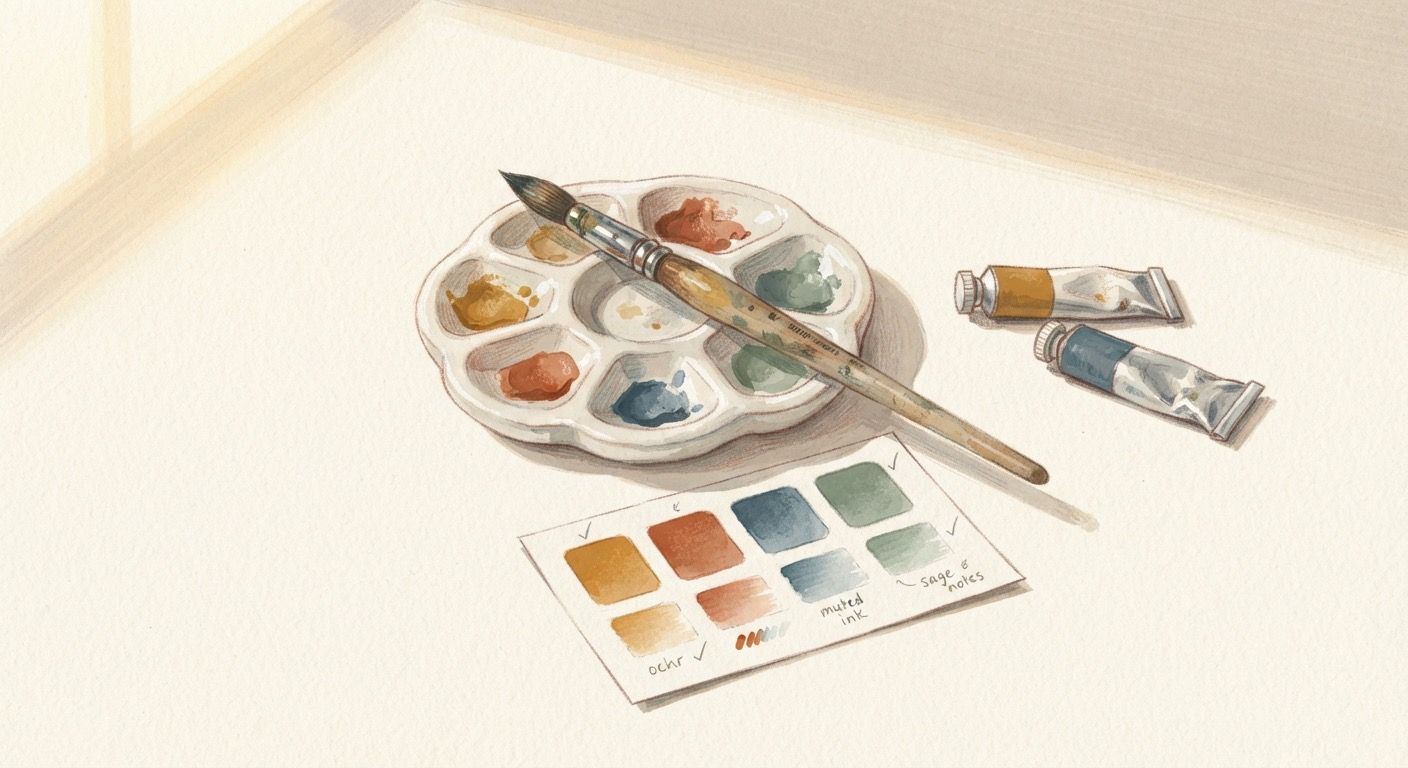
Gouache is opaque watercolor: the same water-based paint, with more pigment and filler so it covers what is underneath and dries flat and matte. The best gouache paint for beginners depends on one choice more than any other: jelly gouache in ready-to-dip cups, or tube gouache you squeeze out and learn to mix. Most of my paintings use the 48-color HIMI Twin Cup jelly gouache set, so it comes first here, labelled “I use this”, followed by two researched starter sets and the order I work in when I start a gouache painting.
The short answer
The set I paint with is HIMI’s 48-color Twin Cup jelly gouache: not a premium brand, but very good paint quality and widely used by artists, as long as you air the case and mist the cups. For a smaller jelly box with a palette and brushes included, the researched HIMI 24-color set is the easiest start. If you would rather learn color mixing, the researched Winsor & Newton 10-tube Designers Gouache set is built around yellow, magenta and cyan plus white and black. Either way, paint on heavy paper, not printer paper.
What gouache does that watercolor and acrylic don’t
- It covers. Light colors sit on top of dark ones, so you can correct mistakes and add highlights last. Watercolor is transparent and works light to dark; see gouache vs watercolor and my watercolor guide.
- It dries matte. Flat, even color with no shine, which is why illustrators and designers use it.
- It rewets. Traditional gouache stays water-soluble when dry, so dried paint on the palette comes back with a damp brush. The flip side: a wet layer on top can lift the one below. Acrylic dries permanent instead; see gouache vs acrylic and my acrylic paint guide.
“Acryla gouache” is a separate, acrylic-based paint with the matte look that dries permanent and does not rewet. None of the sets below is acryla gouache.
Jelly gouache vs tube gouache
Jelly gouache, also sold as “pudding” gouache, comes in small cups at a soft, gel-like consistency: you dip a damp brush straight into the cup. Tube gouache is the traditional paste you squeeze onto a palette. Both are water-based, dry matte and rewet with water; the differences are in format, care and grade.
| Jelly gouache | Tube gouache | |
|---|---|---|
| Setup | Open the case and dip | Squeeze onto a palette |
| Colors | Many, ready-made | Usually fewer; you mix |
| Grade | Mostly student-grade sets | Student to professional lines |
| Storage | Paint stays moist in closed cups | Unused paint stays sealed in the tube |
| Care | Air the case, mist the cups | Close caps tightly so they do not dry |
| Watch for | Mold, or cups drying hard | Dried caps |
In a jelly box like my twin-cup set, every cup is exposed whenever the lid is open. That is why a jelly set needs regular use and airing with the case open so the cups do not mold. I mist my cups with the HIMI Gouache Wetting Spray instead of water to keep the paint moist and its texture intact. Tubes skip that routine: you squeeze out only what a painting needs and the rest stays fresh. The full jelly routine, step by step, is in how to use jelly gouache.
Choose jelly if you want many colors open at once; in my 48-color twin-cup tray I pull shades straight onto a mixing palette. Choose tubes if you want to learn mixing from a few colors, or to leave paint untouched between sessions. One reviewer, Fearless Brush, found HIMI’s jelly paint sticky to work with. HIMI is not a premium brand, but in my use its paint quality is very good.
How many colors do you need?
Fewer than you think. A warm and cool version of each primary plus white is a full palette, and white is the color you will use most, because gouache gets lighter by adding white, not water. Big sets save mixing time and are good for matching a reference fast. Small sets force you to learn mixing, which pays off in every medium.
Hands-on: the set I use
The 48-color twin-cup jelly gouache set I own and use for most of my paintings. The specs below are the listing’s own.


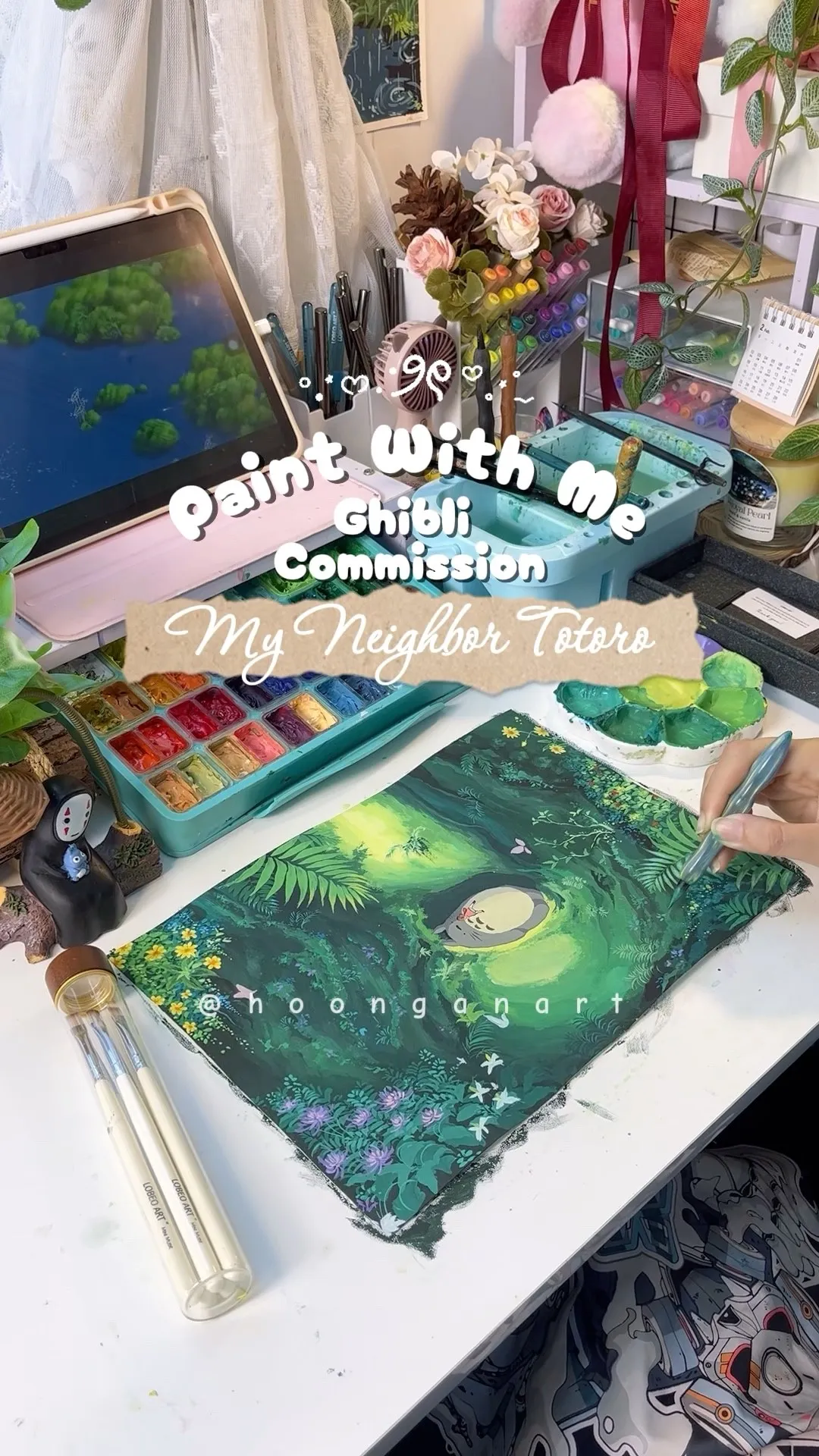 My video
HIMI Twin Cup Jelly Gouache, 48 Colors
$29.69List Price: $32.99Save 10%
as of Nov 3, 2026, 11:15 UTCDetails
Price and availability show on Amazon.
Paid link · I may earn from it
- Colors
- 48 × 12 g
- Format
- Jelly gouache in twin cups
The gouache set I use for most of my paintings: not a premium brand, but very good paint quality that is widely used by artists—as long as you air the box and mist the cups so they do not mold or dry hard.
The full write-up: HIMI Jelly Gouache review, plus my HIMI Gouache Wetting Spray review for how I mist the cups to keep them moist, prevent mold and preserve the paint’s texture.
The researched picks
These two are research-based: compared from each maker’s stated color count, format and finish, and checked on each listing for the exact variant. Not tested hands-on.
 Research-based
HIMI Gouache Paint Set, 24 Colors × 30 ml Jelly Cups
Best all-in-one starter set
Paid link · I may earn from it
- Colors
- 24
- Format
- 30 ml (1 oz) jelly cups with sealing lids
A complete gouache starter in one case: 24 colors in sealed jelly cups, a palette and three brushes. Open a cup and paint; nothing to squeeze or set up.
Twenty-four colors in 30 ml jelly cups with sealing lids, plus a palette and three brushes in a carrying case. The maker describes the paint as thick and creamy with opaque, matte coverage that rewets with water. It is the easiest way to try gouache without buying anything else, apart from paper.
Good fit if
- Beginners who want every color ready in one box, with palette and brushes included
- Illustration, journaling and small studies where many ready-made colors save mixing
- Gift buyers who want a complete, giftable set
Skip it if
- You want to learn color mixing from a few primaries; a small tube set teaches it better
- You need layers that stay put when painted over; gouache reactivates with water once dry
All maker specs
- Colors
- 24
- Format
- 30 ml (1 oz) jelly cups with sealing lids
- Includes
- Palette, 3 brushes, carrying case
- Finish
- Opaque and matte (per listing)
- Rewets
- Yes, with water once dry (per listing)
- Safety label
- ASTM D-4236 and EN71 conformance (per listing)
Worth knowing
- Close each lid after a session and do not leave water pooled in a cup; damp, sealed paint can grow mold.
- Gouache shifts slightly in value as it dries; test a mix on scrap before a large area.
Specs are the maker's own figures from the product listing, not my measurements. Listing checked October 12, 2026 for this exact variant: 24 colors × 1 oz (30 ml) jelly cups, green carrying case, with palette and 3 brushes.How I pick
 Research-based
Winsor & Newton Designers Gouache Paint Set, 10 × 12 ml
Best for learning to mix
Paid link · I may earn from it
- Colors
- 10
- Format
- 12 ml tubes
Ten tubes of Winsor & Newton's long-running Designers Gouache, built around process yellow, magenta and cyan plus white and black, so you learn to mix the colors a big set would hand you.
Ten 12 ml tubes from Winsor & Newton’s Designers Gouache line, including white, black, Yellow Ochre and Ultramarine plus process yellow, magenta and cyan. That last trio is the printer’s palette, so most colors are a mix away. The maker describes a smooth, matte flat finish. Add a couple of brushes and a white palette.
Good fit if
- Learning color mixing from a small, balanced palette
- Flat, even color fields for design and illustration
- Painters stepping up from a craft set to a maker's established gouache line
Skip it if
- You want brushes and a palette in the box; this set is paint only
- You want many ready-made colors without mixing
All maker specs
- Colors
- 10
- Format
- 12 ml tubes
- Includes
- Paint only
- Finish
- Smooth, matte flat (per Winsor & Newton)
- Rewets
- Not stated
- Maker says
- Popular with designers and illustrators since 1935
Worth knowing
- Paint only; add a round and a flat synthetic brush and a white palette.
Specs are the maker's own figures from the product listing, not my measurements. Listing checked October 12, 2026 for this exact variant: 10 colors in 12 ml tubes.How I pick
Three gouache sets, makers' specs
| Set | Colors | Format | Includes | Price | Shop |
|---|---|---|---|---|---|
| My pickHIMI Twin Cup Jelly Gouache, 48 Colors | 48 × 12 g | Jelly gouache in twin cups | 3 brushes | $29.69as of Nov 3, 2026, 11:15 UTCDetails | View on Amazon |
| HIMI Gouache Paint Set, 24 Colors × 30 ml Jelly Cups | 24 | 30 ml (1 oz) jelly cups with sealing lids | Palette, 3 brushes, carrying case | $25.51as of Nov 3, 2026, 11:21 UTCDetails | View on Amazon |
| Winsor & Newton Designers Gouache Paint Set, 10 × 12 ml | 10 | 12 ml tubes | Paint only | $19.99as of Nov 3, 2026, 11:21 UTCDetails | View on Amazon |
The Winsor & Newton colors
- Titanium White
- Process Yellow
- Cadmium Yellow Deep Hue
- Cadmium Red Hue
- Process Magenta
- Ultramarine
- Process Cyan
- Permanent Green Middle
- Yellow Ochre
- Mars Black
How to start gouache painting as a beginner
This is the order I work in when I paint with gouache, as my Studio Ghibli fan-art paint-along Shorts show. The Shorts themselves are on my Ghibli gouache painting page.
- Wake up the paint. Before anything else, I mist my open jelly cups with the wetting spray, as at the start of my Spirited Away paint-along. With tubes, squeeze out only what the painting needs.
- Set out two waters. I use a two-compartment brush wash bowl: one side to rinse brushes, the other for water to mix paint.
- Sketch first, with a reference in view. I sketch the scene before painting; for my Totoro paint-along I worked from a reference propped on my tablet.
- Mix the whole palette before you paint. I have a habit of mixing all the colors of a painting before I start: sky tones, sunlit greens, midtones and deep shadows, each in its own well of my 14-well ceramic palette. Then I can move from sky to foreground without stopping to remix.
- Go from big areas to small details. In my Only Yesterday paint-along, I lay the sky gradient with a wide flat brush, then block in the distant hills with a round brush, build up the fields and bushes, and finish with fine dark grass blades and white wildflowers.
- Control the water. With plenty of water, gouache flows and blooms like watercolor; with very little, it covers like acrylic. Mastering gouache comes down to controlling the water on your brush.
MEEDEN sent me the bowl and the palette for free. The technique advice in the tips below is established practice.
Paper and brushes
- Paperwatercolor paper or heavy mixed-media paper, around 300 gsm, so the page does not buckle. My sketchbook guide explains paper weights by medium.
- Brushessynthetic rounds and flats in a few sizes. A small flat lays even color fields; a fine round does detail and lettering. My brushes for gouache guide covers the LOBEO ART brushes I paint with on camera and three researched sets.
- Palettewhite, so you judge mixes against a neutral surface. A plastic or ceramic palette rewets cleanly; I use the 14-well MEEDEN ceramic palette to pre-mix all the colors of a painting before I start. Ceramic vs plastic palettes compares the two materials.
Five beginner tips
- Get the consistency right. For flat, even coverage, aim for the thickness of light cream. Too thin and it streaks like watercolor; too thick and it can crack.
- Mix more than you need. Matching a mix later is hard, and running out mid-area leaves a visible join.
- Test on scrap. Gouache can dry slightly lighter or darker than it looks wet.
- Work in few strokes. Scrubbing a dry layer with a wet brush lifts it; lay color and leave it.
- Light colors last. Add highlights at the end, when the layers below are dry.
As a Christmas gift
A gouache starter kit is an easy Christmas gift because a jelly set opens and paints straight away:
- All in one casethe researched HIMI 24-color set, with a palette and three brushes.
- More colorsthe 48-color HIMI Twin Cup set I paint with, plus a bottle of HIMI Gouache Wetting Spray to keep the cups moist.
- For learning to mixthe Winsor & Newton 10-tube set with a white palette.
Pair any of them with heavy paper of about 300 gsm, and with the two MEEDEN pieces from my gouache routine above: the 14-well ceramic palette and the two-well brush wash bowl. More ideas are in my gifts for artists guide and stocking stuffers for artists.
Questions
What is the difference between jelly gouache and tube gouache?
Jelly gouache comes in cups at a soft, gel-like consistency you dip a brush into; tube gouache is a paste you squeeze onto a palette. Both dry matte and rewet with water. Jelly sets give you many colors ready at once but need airing and misting so the cups do not mold or dry hard; tubes keep unused paint sealed.
Is gouache easier than watercolor for beginners?
It is more forgiving in one way: because it covers, you can paint over a mistake once it dries. Watercolor rewards planning; gouache lets you correct.
Can I use gouache on canvas?
The HIMI listing names canvas and paper. Gouache is usually used on paper; for large canvas work, acrylic is the more common choice.
Do I need to varnish gouache?
Usually not. Frame finished paintings behind glass. A varnish can darken the matte finish, so test one on scrap first.
Can I mix jelly gouache and tube gouache?
Both are water-based gouache, so the colors mix on a palette. Brands differ in texture, so try a mix before a full painting.