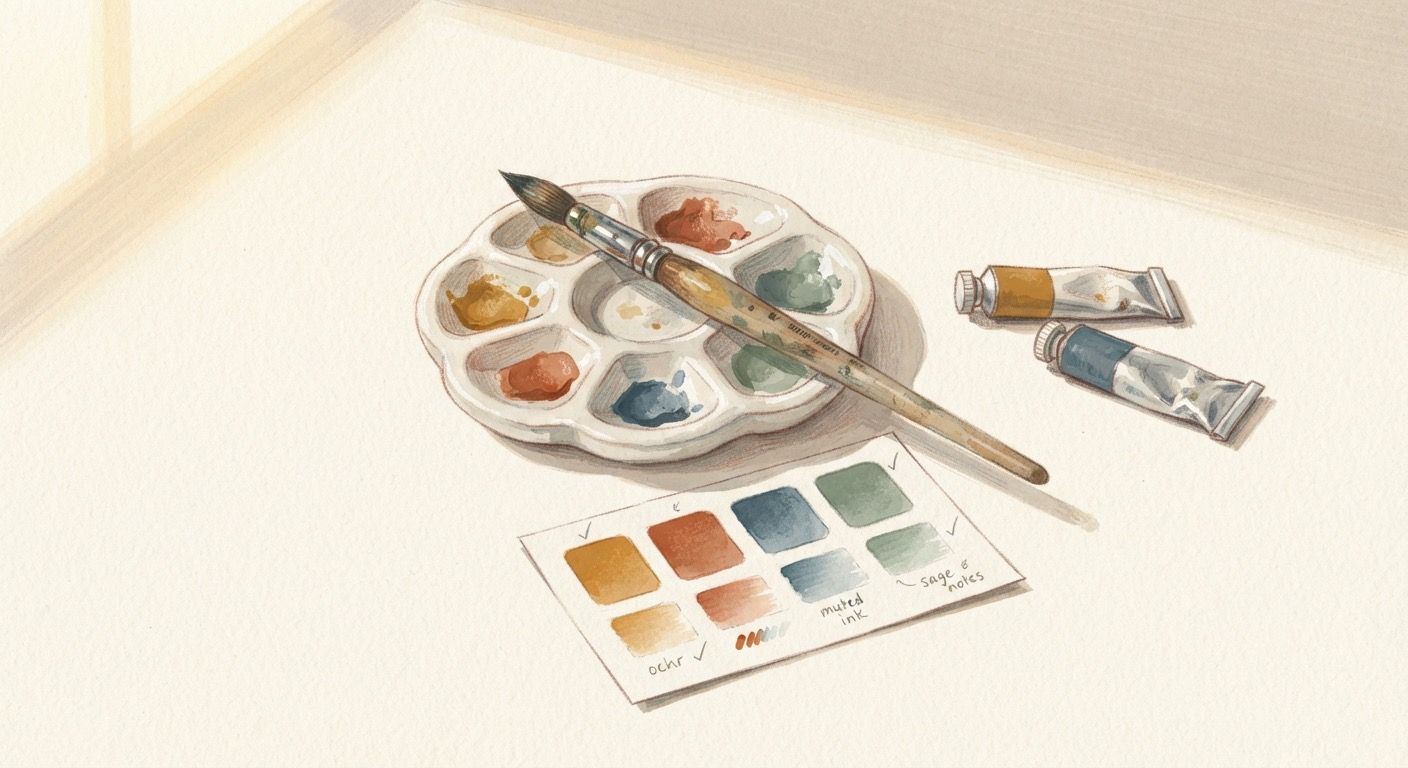
Jelly gouache is gouache sold as soft paint in open cups instead of tubes, and learning how to use jelly gouache comes down to three habits: keep the cups moist, mix on a palette, and control the water on your brush. This guide walks through each step as my HIMI gouache painting Shorts show it, and labels the tips they do not show as research-based.
The short answer
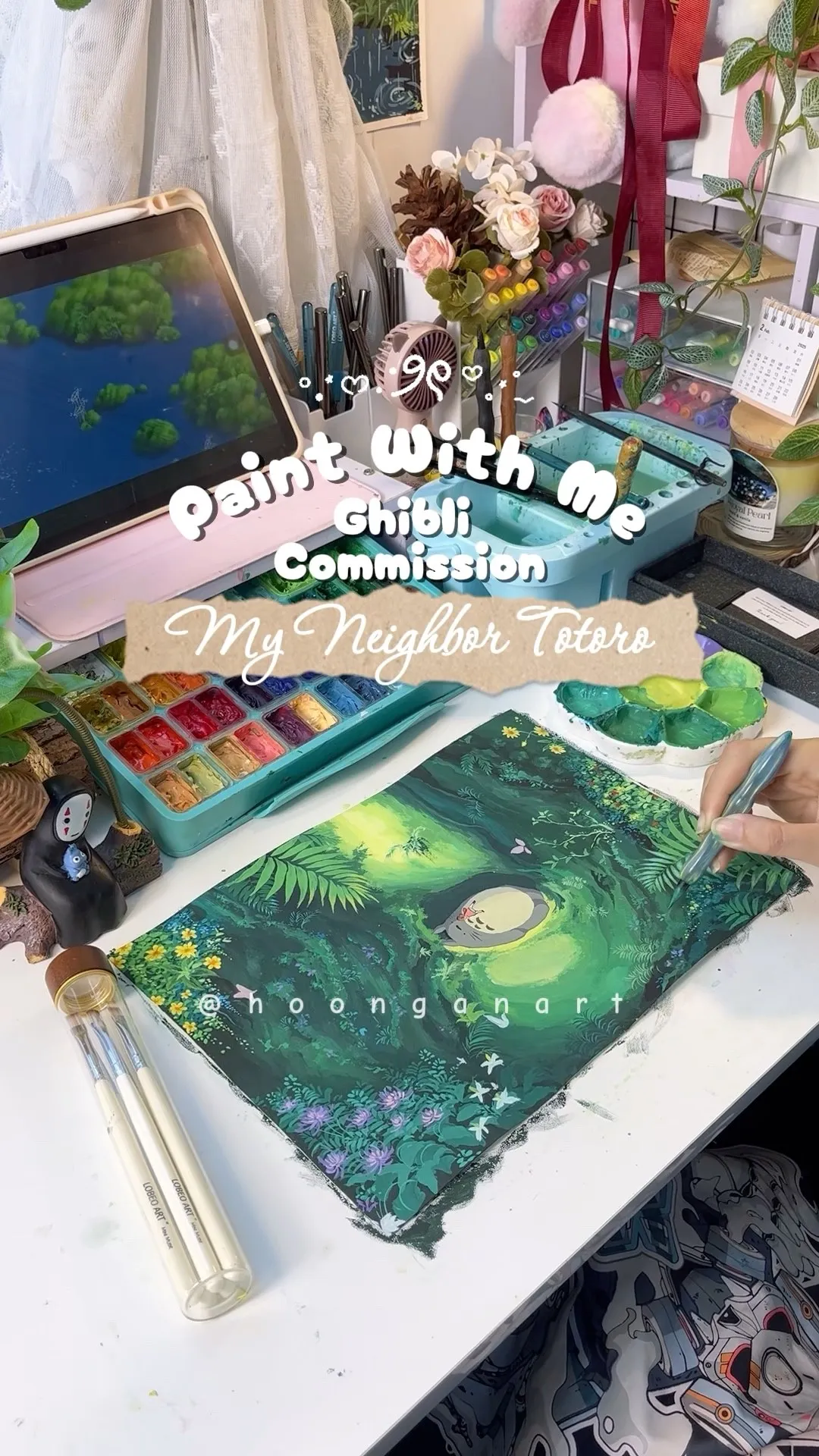
Mist the cups before you start, mix your colors on a palette, then let water decide the finish: plenty of water for watercolor-like washes, very little for flat, opaque cover. Between sessions, use the box regularly, air it out and mist it so the paint does not mold or dry hard. To start small, the researched pick is HIMI’s 24-color jelly-cup set; I paint with the 48-color HIMI Twin Cup set and mist it with the HIMI Gouache Wetting Spray.
What makes jelly gouache different
It is the same water-based, opaque paint; what changes is the packaging. HIMI’s Amazon listing for its 24-color jelly-cup set describes the paint as thick and creamy, with a matte finish that can be rewet with water once dry, and a jelly box keeps every color open and ready at once, where a tube stays sealed until you squeeze it. That is why using jelly gouache starts with cup care. The jelly vs tube gouache table in my beginner gouache guide compares setup, grade, storage and care, and gouache vs acrylic explains how gouache differs from the paint it most resembles.
What you need on the desk
Everything here is on my desk in my gouache Shorts:
- Painta jelly gouache box. Mine is the 48-color HIMI Twin Cup set, open beside the paper in each of my gouache Shorts on this site.
- Palettea white mixing palette. My Shorts show a flower-shaped palette, a rectangular one and my 14-well MEEDEN ceramic palette.
- Watera two-well brush washer, or my MEEDEN ceramic brush wash bowl.
- Brushesa wide flat brush for skies and washes, round brushes for shapes, and water brushes for foliage.
- Papera heavy watercolor journal or sketchbook painted across a two-page spread and held flat with binder clips. The Fuumuui journal in one Short is 300 g cold-pressed cotton, per its paper band; my sketchbook guide explains paper weight by medium.
- Wetting sprayI use the HIMI Gouache Wetting Spray on the cups instead of plain water.
How to use jelly gouache, step by step
These steps follow my Shorts in the order they happen on camera; the timestamps point to the moment in each one. To see whole paintings come together, my Ghibli gouache painting page gathers the Shorts; for small seasonal pieces, my gouache Christmas cards guide puts the same steps on a card.
- Mist the cups first. At
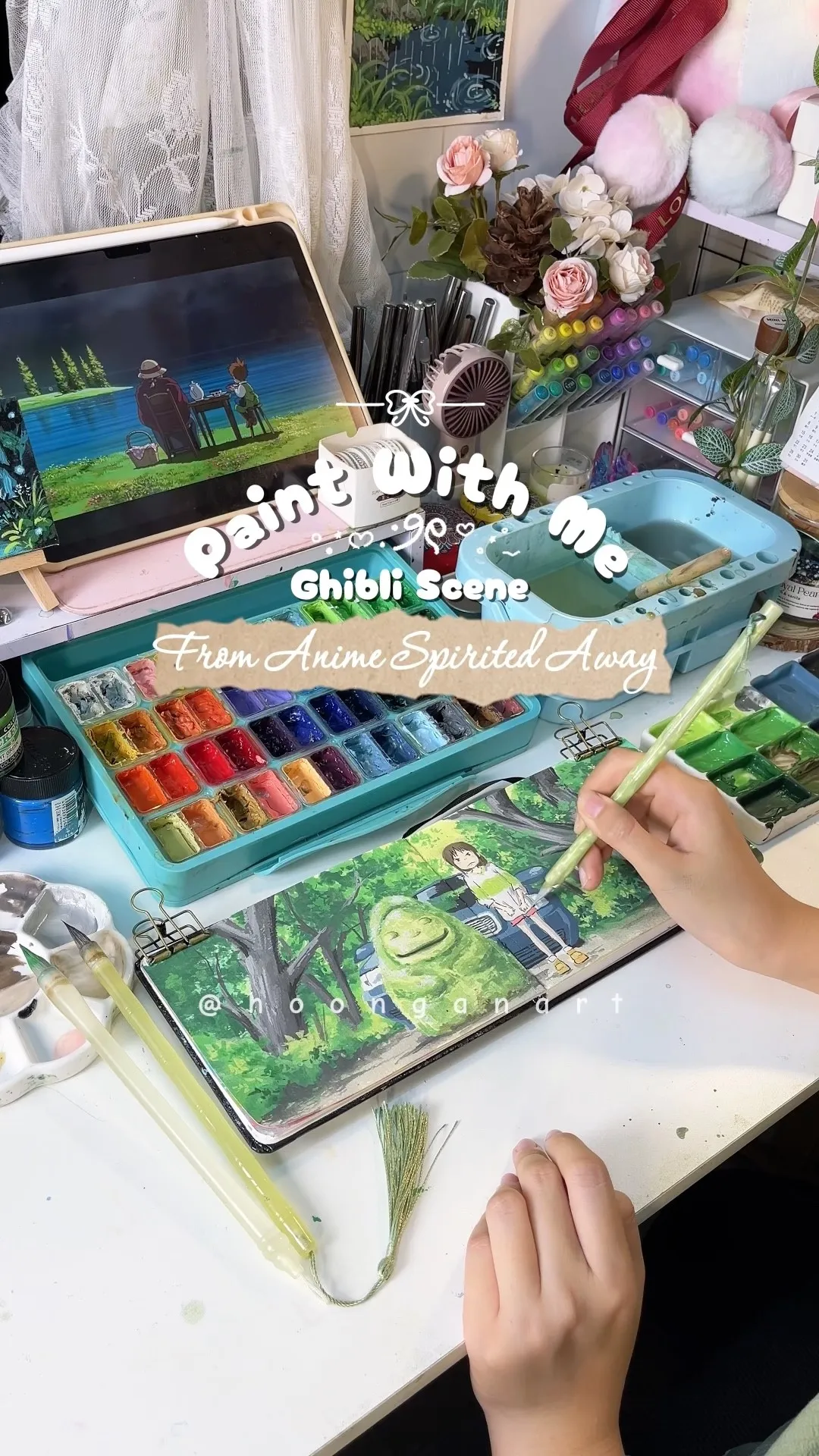
0:02–0:03of my Spirited Away Short, before I set out my brush washer and palette, I mist the open box across the rows of twin cups with my wetting spray. - Set out clean water and a clean palette. In my
Only Yesterday palette Short (
0:03–0:06), the HIMI box is open on the desk and I pour water into my brush washer behind an empty, clean palette. - Mix the painting’s colors before you paint. I have a habit of mixing all the colors of a painting before I
start. In the same Short (
0:11–0:13), I fill all 14 wells of my palette, from sky blues and yellow-greens to forest greens and shadow mixes, before the brush touches the paper. - Sketch and clip the spread flat. In my Spirited Away Short (
0:08–0:10), I sketch the scene in blue pencil across both pages; in my Fuumuui journal Short (0:10–0:12), two brass binder clips hold the pencil-sketched spread open at the corners. - Lay the big washes. In each of these Shorts the first paint is a large wash: a turquoise-blue to pale yellow sky gradient
with a wide flat brush (
0:14–0:16, Only Yesterday), a yellow wash across both pages and the center fold (Fuumuui journal Short), or a pale yellow-green wash and then a light green layer (0:11–0:17, Spirited Away). - Build the scene in layers. With a round brush I block in a dark wooded ridge and blue-grey clouds
(
0:17–0:21, Only Yesterday); in Spirited Away, the gray tree trunks, sunlit and shaded foliage, the car and the mossy statue are built up over the washes (0:18–0:43). - Finish with the small details. Fine dark grass blades and white wildflowers close my Only Yesterday painting
(
0:45–0:52); in Spirited Away, I paint Chihiro in front of the car before holding up the finished spread (0:44–0:59). - Unclip and check the spread. I unclip the binder clips and hold the finished spread up to the camera
(
0:53–0:58, Only Yesterday).
Water control: watercolor washes or acrylic-like cover
Controlling the amount of water on your brush is the key to mastering gouache. Mixed with plenty of water, it flows and blooms like watercolor; mixed with very little, it lays down opaque, flat color like acrylic. Jelly gouache is no different once it is on the palette. My HIMI Jelly Gouache review has more on how the 48-color set handles, and the five beginner tips in my gouache guide cover consistency and layering.
What my Shorts don’t show: research-based tips
These come from common jelly gouache advice and the makers’ listings, not from my own testing:
- Keep the cups cleanrinse the brush before you dip into the next cup, or lift paint onto the palette with a clean, damp brush, so one color does not muddy the cup beside it.
- Revive a dried cupHIMI’s listing says its wetting spray reactivates dried gouache; a little clean water on the surface and a short wait is the common alternative.
- Leave dry layers alonegouache rewets once dry, so scrubbing a dry layer with a wet brush lifts it. Lay a stroke and leave it, and add light colors last.
- No pooled water in a closed cupdamp, sealed paint can grow mold, which is why the box needs airing as well as misting.
- Mist with distilled water, not tapif you mist with water rather than a wetting spray, Jerry’s Artarama’s jelly gouache guide advises distilled water only, because trace impurities in tap and bottled water can grow mold in damp paint.
- Expect some colors to fadeThe Fearless Brush’s HIMI review found pigment codes for only 2 of the 24 colors and notes that many are typically not lightfast, the lighter tones especially fading in sunlight. Keep finished paintings out of direct sun.
Caring for the box between sessions
A jelly box needs regular use and airing so trapped moisture does not make the cups mold, and misting so the paint does not dry hard. I mist with the HIMI Gouache Wetting Spray instead of plain water: it keeps the paint moist, prevents mold and keeps the gouache’s texture intact. HIMI’s own instructions are to spray two to three times onto the paint, or mist evenly across the cups before closing the cover. My wetting spray review covers the routine in full.
Researched pick: jelly gouache to start with
This one is research-based: chosen from HIMI’s stated color count, cup size and contents, and checked on its listing. Not tested hands-on.
 Research-based
HIMI Gouache Paint Set, 24 Colors × 30 ml Jelly Cups
Best first jelly-cup set
Paid link · I may earn from it
- Colors
- 24
- Format
- 30 ml (1 oz) jelly cups with sealing lids
A complete gouache starter in one case: 24 colors in sealed jelly cups, a palette and three brushes. Open a cup and paint; nothing to squeeze or set up.
Twenty-four colors in 30 ml jelly cups with sealing lids, plus a palette and three brushes in a carrying case. HIMI describes the paint as thick and creamy with opaque, matte coverage that rewets with water. Larger single cups and fewer colors than the 48-color set make it the smaller way to try every step above.
Good fit if
- Beginners who want every color ready in one box, with palette and brushes included
- Illustration, journaling and small studies where many ready-made colors save mixing
- Gift buyers who want a complete, giftable set
Skip it if
- You want to learn color mixing from a few primaries; a small tube set teaches it better
- You need layers that stay put when painted over; gouache reactivates with water once dry
All maker specs
- Colors
- 24
- Format
- 30 ml (1 oz) jelly cups with sealing lids
- Includes
- Palette, 3 brushes, carrying case
- Finish
- Opaque and matte (per listing)
- Rewets
- Yes, with water once dry (per listing)
- Safety label
- ASTM D-4236 and EN71 conformance (per listing)
Worth knowing
- Close each lid after a session and do not leave water pooled in a cup; damp, sealed paint can grow mold.
- Gouache shifts slightly in value as it dries; test a mix on scrap before a large area.
Specs are the maker's own figures from the product listing, not my measurements. Listing checked October 12, 2026 for this exact variant: 24 colors × 1 oz (30 ml) jelly cups, green carrying case, with palette and 3 brushes.How I pick
Hands-on: the jelly gouache I use
The set and spray from the steps above. The specs below are the listings’ own.


 My video
HIMI Twin Cup Jelly Gouache, 48 Colors
$29.69List Price: $32.99Save 10%
as of Nov 3, 2026, 11:15 UTCDetails
Price and availability show on Amazon.
Paid link · I may earn from it
- Colors
- 48 × 12 g
- Format
- Jelly gouache in twin cups
The gouache set I use for most of my paintings: not a premium brand, but very good paint quality that is widely used by artists—as long as you air the box and mist the cups so they do not mold or dry hard.
The full write-up: my HIMI Jelly Gouache review.


 My video
HIMI Gouache Wetting Spray, 100 ml
$10.79List Price: $11.99Save 10%
as of Nov 3, 2026, 11:15 UTCDetails
Price and availability show on Amazon.
Paid link · I may earn from it
- Volume
- 100 ml (3.38 fl oz) on this ASIN; 200 ml (6.76 fl oz) option on listing
- Format
- Fine-mist pump spray bottle
The spray I use on my gouache instead of plain water: it keeps the paint moist, helps prevent mold in the tray, and keeps the gouache's texture intact.
How I use it on the cups: my HIMI Gouache Wetting Spray review.
Two HIMI jelly gouache sets, makers' specs
| Set | Colors | Format | Includes | Price | Shop |
|---|---|---|---|---|---|
| My pickHIMI Gouache Paint Set, 24 Colors × 30 ml Jelly Cups | 24 | 30 ml (1 oz) jelly cups with sealing lids | Palette, 3 brushes, carrying case | $25.51as of Nov 3, 2026, 11:21 UTCDetails | View on Amazon |
| HIMI Twin Cup Jelly Gouache, 48 Colors | 48 × 12 g | Jelly gouache in twin cups | 3 brushes | $29.69as of Nov 3, 2026, 11:15 UTCDetails | View on Amazon |
Questions
Do you add water to jelly gouache?
Yes. The amount of water on your brush decides how it behaves: with plenty of water it flows like watercolor, and with very little it gives opaque coverage like acrylic.
Should you mix jelly gouache in the cup or on a palette?
On a palette. My Shorts show me mixing on a palette before painting, and the common advice is that keeping mixes out of the cups keeps each color clean.
How do you keep jelly gouache from drying out or molding?
Use the set regularly, open the case to air it out so the cups do not mold, and mist the paint with clean water or a gouache wetting spray so it does not dry hard. I use the HIMI Gouache Wetting Spray instead of water.
What paper works with jelly gouache?
Heavy watercolor paper, around 300 gsm, so the page does not buckle. My Shorts paint across two-page spreads, two in bound watercolor journals and one in a sketchbook; my sketchbook guide compares paper by medium.